
Norco, CA, May 18, 2026 - The Ecological Design Challenge posed big questions about how site furnishings can do more than their obvious functions. Our esteemed judging panel was wowed by the dozens of submissions, and after careful deliberation, two were named the winners: “Rain Flowers” by Future Forward Design Collective in the professional category, and “Aftercast” by Gustavo Gonzalez Contreras in the student category.
Below, learn the backstory of each thoughtfully designed project, and hear about the winners’ thoughts on shaping more sustainable and resilient cities.

Future Forward Design Collective splashed onto the scene with their award-winning design, “Rain Flowers.” The downspout habitat planter and informal seating feature pushed the limits of what site furnishings can achieve, creating a space where you can move and even slow down rainwater, while also providing a hydration station, wildlife habitat, and extra seating.
.jpeg)
Landscape architects Wendy Chan, Jessica Roberts, Jenni Zell, and Chuan Ding have worked closely on projects over the years, but in December 2025, they formed the Future Forward Design Collective. Hoping to brainstorm and explore their many curiosities outside of their 9-to-5s, these landscape experts—each of whom has more than a decade of experience in the industry—saw the design competition as their motivation to officially work as a collective.
“We've been thinking and talking for a long time, and to be honest, the design competition made us do what we've been talking about for a long time,” Zell explains. “It's a space for deeper thinking, getting together, and co-mentoring. We don't even know exactly where it's going to go, but this is part of the story.”
Beyond the impressive functionality of “Rain Flowers” is the artistic design by Jessica Roberts, who earned an undergraduate degree in sculpture before pursuing her master’s degree in landscape architecture. Inspired by the yerba mansa or lizard tail plant, these organic flowers were reimagined as precast concrete structures.
“When exploring the form, it's something that was really sculptural, and also interactive that would draw attention to a rain event,” Roberts says. “The flowers celebrate the rain event, but then also slow stormwater and provide a wildlife habitat. The brainstorm was long and lengthy, but those were the pieces that came together.”

The design competition pushed the team to consider a number of potential ecological benefits, and allowed them to dream up the products they’ve always wanted to specify.
“We get so caught up in working on projects that there are times we wish there was a solution that can combine beauty and function, and achieve what the project needs,” Chan says.
The story of the collective is still being written, but for now, they see site furnishings as a unique opportunity to transform spaces for the community and all of its inhabitants.
“We design places that other people occupy, or maintain, and what this design competition brought forth was that we're one among many other species that are out there,” Zell says. “How do we improve biodiversity in our communities, how do we be climate adaptive, and how does that work into products? And just designing with species' lifecycles in mind. We think about it in planting, but to think about it in site furnishing is pretty cool, too.”

Gustavo Gonzalez Contreras, the winner of our student competition, developed “Aftercast,” a modular system designed to redirect stormwater, control erosion and stabilize soil, and create micro-ecosystems for wildlife and plants. This month, he earned his Bachelor of Architecture (B.Arch) from the University of Houston Hines College of Art & Design.

Before the design competition was announced, the beginning of “Aftercast” started in ARCH 5500: Ecology + Infrastructure, an advanced design studio helmed by Professor Roya Plauché, the director of the Hines Environmental Design program. Contreras credits his professor for inspiring his work, explaining that the studio focused on modeling and developing environmental design as a response to biodiversity laws, and looking into the relationship between built environments and natural systems. There were three primary domains—terrain, water, and air—divided into macro, meso, and micro scales.
“That really helped me understand the kind of research that it takes to try to solve a problem on a smaller scale,” he says. “When Professor Plauché introduced me to the competition, I was thinking to myself, This is similar to something I've done in her studio. It was a different project, though, revolving around mushrooms and how to create a structure regenerating and harvesting mushrooms. I wanted to do something like that, but only using what the competition says: precast concrete.”
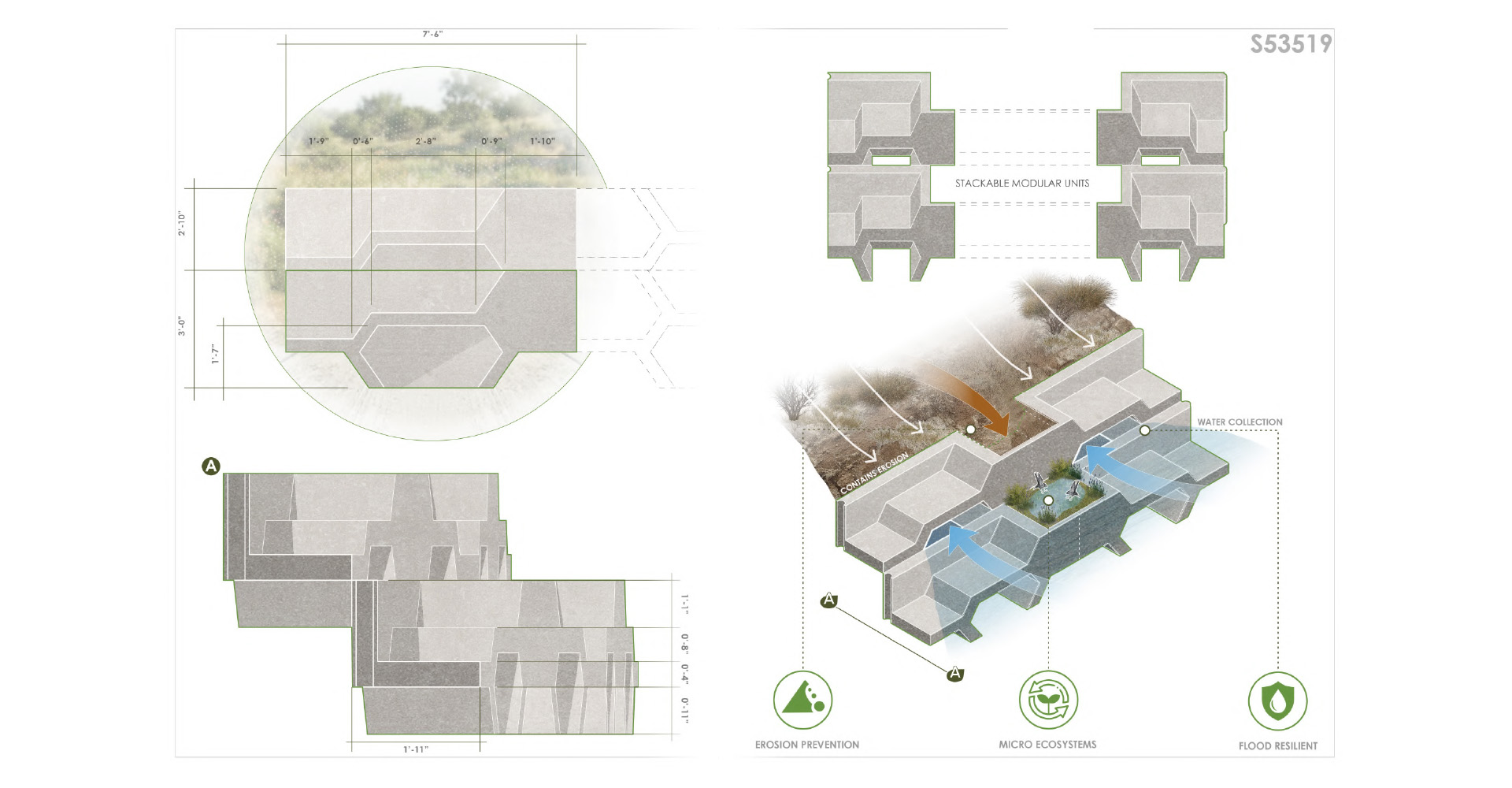
From there, Contreras got personal with his project, thinking more critically about his own environment in Houston. With so many factories surrounding the city, waterways have been contaminated, and they frequently experience hurricanes and flooding. During one hurricane, Contreras’s home nearly flooded. Combined with the amount of construction going on in the leadup to the 2026 FIFA World Cup, he started thinking about how concrete could be repurposed.
“Aftercast” is inspired by a traditional retaining wall, and when stacked, Contreras’s honeycomb-like bench seating could direct water and create pockets to preserve what he calls “micro-ecosystems.”

“The one big lesson I learned is designing with flexibility and adaptability in mind, even if it's a small design approach,” he says. “Using small design elements can contribute to a larger environmental impact. This project really taught me to think more critically about the role that design plays in shaping resilience in sustainable environments.”
As he prepares for a career in architecture post-graduation, Contreras is also looking forward to working alongside the QCP team to bring “Aftercast” to life. “I find it very valuable seeing the manufacturing part, and the industry constraints and working through all of that,” he says. “I get to broaden my world, and that's what I'm really looking forward to.”







.svg)
.svg)